Throughout the Humanities Core Course, we have analyzed how imperialism and colonialism affect the conquerors and conquered. By exploring texts from the Romans to the Incas, we have seen how empire inspires revolutions, cultural transformations, and new schools of thought. As I learned more and more about the motives of empire, my mind flooded with questions, such as who decides what it means to be civilized versus uncivilized? And where does this idea that “to be white” means to be more civilized?
I believe that upon discovering the existence of other countries, Westerners staked their claim on the land and used their arrogance and self-righteousness to impose their rule. For example, in 1898, the American seized control of the Philippine Islands under the Treaty of Paris, which forced the Spanish empire to relinquish their sovereignty over the Philippines. Prior to the treaty, the Philippines, under the leadership of Andrés Bonifacio, had been revolting against Spanish colonial rule and hoped that the Treaty of Paris would lead to their ultimate emancipation. Unfortunately, instead of granting the Philippines independence like they promised, President McKinley issued a Proclamation of Benevolent Assimilation, a policy officially making the Philippines a US territory (“Philippine-American War”). The US truly believed that their actions of conquest were justified because as the superior nation, they had the right and responsibility to help and “civilize” the downtrodden.
During the time of Western imperialism, Rudyard Kipling wrote the poem“The White Man’s Burden” that justified the American conquest of the Philippines by defining their reign as a humanitarian effort:
Take up the White Man’s burden —
Send forth the best ye breed–
Go bind your sons to exile
To serve your captives’ need;
To wait in heavy harness,
On fluttered folk and wild–
Your new-caught, sullen peoples,
Half-devil and half-child (Kipling, lines 1-8)
The infamous “White Man’s Burden” proposes that the white race is morally obligated to rule the non-white peoples of Earth and to encourage their progress through settler colonialism. The specific use of the word “burden” and the phrase “bind your sons to exile” implies that Americans are doing the people a favor by deliberately shouldering their “problems” and helping them become “civilized” without any praise; the use of “exile” adds further negative connotations to the piece that attempt to gain sympathy from the reader and inspire nationalism due to the graciousness of their white country.
Kipling further perpetuates the idea of colonial imperialism and racial superiority and hegemony by defining the Filipinos as “new-caught, sullen peoples,/ Half-devil and half-child.” The terms “new-caught” and “half-devil” further dehumanize the Filipinos as lesser barbaric beings by associating them to the devil and by implying that they are like animals caught in the jungle. The picture below further demonstrates how Westerners perceived non-white peoples.
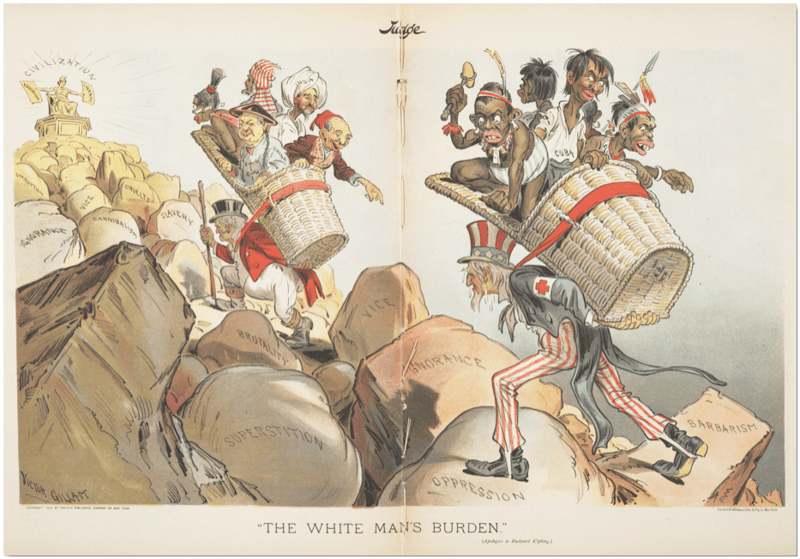
John Bull (Great Britain) and Uncle Sam (U.S.) bear “The White Man’s Burden” (Apologies to Rudyard Kipling), by delivering the coloured peoples of the world to civilization. (Judge magazine, 1 April 1899)
In the cartoon, Western figures carry non-white people to civilization. The gross misrepresentation of the ethnic people as foolish savages further justifies the American conquest of the Philippines and fuels nationalism. Americans can gladly support the colonization of the Philippines when they believe that their occupation is for humanitarian reasons. The “gracious American” has come to save the day.
Propaganda, such as the ones demonstrated, has allowed for the lasting myth that the white way is the only way. Kipling’s “The White Man’s Burden” also demonstrates how empire uses language to manipulate. By creating the term “White Man’s Burden,” Westerners have a reason to invade and colonize non-white people. From analysis of different texts and historical moments, the idea of “civilness” is derived from the people in power. Their terms define who is human and who is not because they have the means and strength to enforce their rule. Thus, the “white way” became the “right way” when Western colonizers used brute force and forced cultural assimilation to subjugate indigenous people so that they can take control of the land and gain further economic prosperity. The humanitarian veil simply hid the true motive of colonization.
When rebelling against the Americans, Filipino President Aguinaldo issued a counter-proclamation to the Proclamation of Benevolent Assimilation that exposed the hypocrisy of the American rule: “My government cannot remain indifferent in view of such a violent and aggressive seizure of a portion of its territory by a nation which arrogated to itself the title of champion of oppressed nations” (“Philippine-American War”). This quote resonated with me as the self-proclaimed title of “champion of oppressed nations” screamed arrogance and righteousness of the Western colonial narrative.
To this day, the idea of the “White Man’s Burden” prevails. The US continues to own territories and involve itself in foreign affairs because it sees its first world privilege as a free pass to meddle as much as possible.
Works Cited
- Gillam, Victor. “The White Man’s Burden (Apologies to Rudyard Kipling). Judge Magazine, 1 Apr. 2019.
- Kipling, Rudyard. The White Man’s Burden. 1899.
- “Philippine–American War.” Wikipedia, Wikimedia Foundation, 10 Mar. 2019, en.wikipedia.org/wiki/Philippine–American_War#Philippine_Revolution.

 Journey through the Past