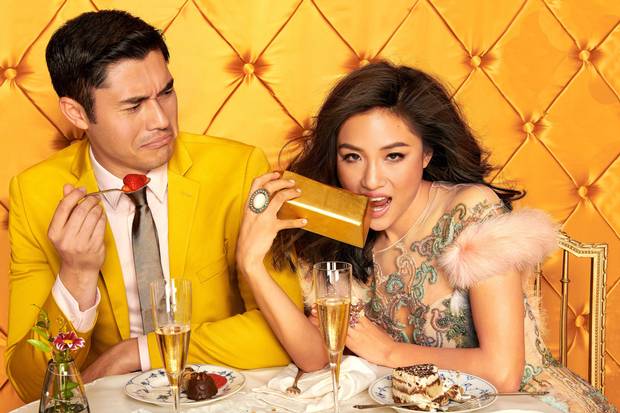
Henry Golding (Nick Young) and Constance Wu (Rachel Chu) pose for Crazy Rich Asians Promotion for Entertainment Weekly
Jon M. Chu’s Crazy Rich Asians has proved to be a landmark film, garnering high praise for being the first film by a major Hollywood studio to feature a majority Asian American cast in a modern setting since The Joy Luck Club in 1993. As of October 10, 2018, the film has grossed $170.1 million in the United States and Canada and $227.1 million worldwide. It has become the highest-grossing romantic comedy of the last 10 years, and the 6th highest grossing ever. The movie centers on Rachel Chu overcoming social obstacles in order to be with longtime billionaire boyfriend Nick Young. Along the way, she learns what it means to be Chinese and Chinese-American and discovers that love knows no bounds. Though Crazy Rich Asians was well received domestically, it failed to reach international success and only grossed $57 million internationally (“Crazy Rich Asians (2018)”). This largely has to do with the fact that many Asians did not find the movie “Asian enough.”
Why?
Although the film does succeed in featuring a majority Asian American cast and paving the way for Asian representation in American media, it fails to capture the true narrative of the average Chinese and Chinese-American and fully represent the diverse Singaporean population. Instead, Crazy Rich Asians perpetuates racial stereotypes and presents a one-dimensional version of Asia that is “palatable” for Hollywood audiences.
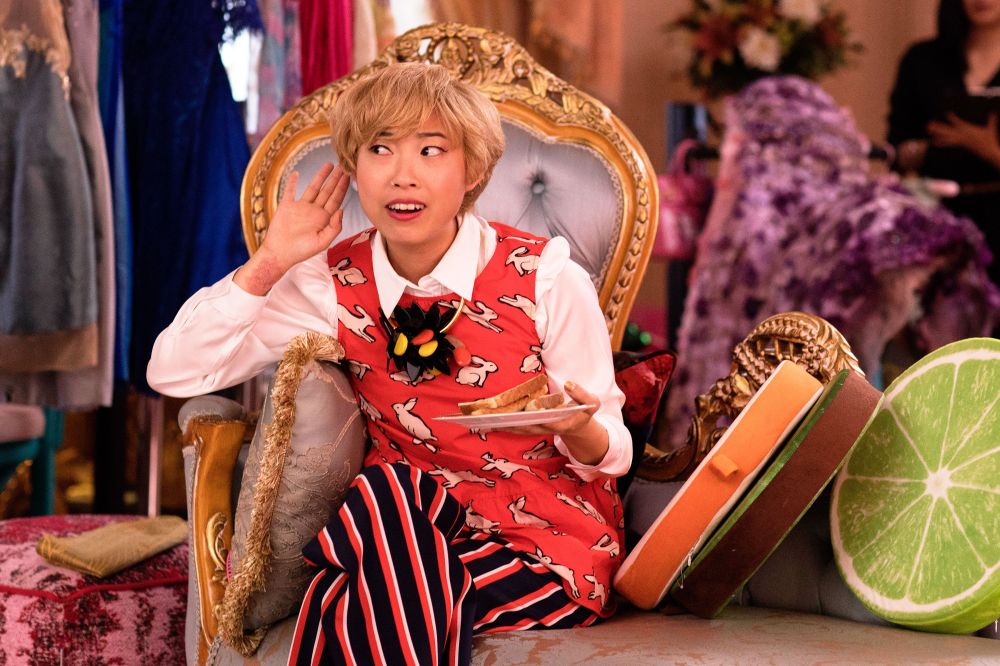
Peik Lin played by Awkwafina in Crazy Rich Asians (2018)
One of the major pitfalls of the movie is that is is mainly written and portrayed through a Western lens. Peik Lin Goh’s gaudy family and the ridicule and rejection of Chinese tradition made the film hard to watch for many Chinese Americans as they saw their culture be perverted for monetary gain. My friend Angela Weber, upon seeing Peik Lin’s family, felt offended by their crass and ostentatious nature. She was put off by their overly dramatic, tawdry clothes and house that made them look like “Chinese trash” and “wannabe Americans.” The Goh family were portrayed as caricatures rather than realistic people. To her, the portrayal of the Goh family as comic relief was as offensive as the depiction of the Original Jim Crow (Luna and Weber). Both depictions of cultural minorities are used to grossly highlight the crude stereotypes of their respective races in order to fit the image painted by the West. The excessive richness and grandeur of the parties as well as the portrayal of the Goh family further distanced the Chinese and Chinese-American viewer from connecting with the clearly Western-influenced characters.
Furthermore, instead of embracing Chinese culture, the film rejects Chinese tradition by ridiculing filial piety, the virtue of respect for one’s ancestors. Unlike Western culture, the family is the most important social unit in Chinese culture; your duty is to your family. The film derides this tradition by painting matriarch Eleanor Young, the mother of leading male protagonist Nick Young, as the villain of her son’s love story. Through a Western lens, Eleanor is a cruel, cold socialite interested in only keeping the money in the family and ensure that her son marries a rich woman to enhance the Young wealth. She seems like a cruel dictator with no care for her son’s happiness, so thus, her son’s rebellion is justified. However, through a Chinese lens, Eleanor is protecting her family; her goal is to ensure that Nick and her future descendants can continue to live on proudly and comfortably. She simply wants what is best for her family. Nick, in return, would respect her decision and put his family first because family is what sticks with you until the end of time. By depicting the tradition of putting family first as an unbearable hindrance, the film rejects this aspect of Chinese culture. Instead, Crazy Rich Asians promotes Western ideals as the more accepting and “right” way of living, while the Chinese tradition of filial piety is outdated and archaic. This is similar to how Professor Lazo noted that the idea of “Latinx” is a very Western principle; it’s a movement to make Latin America more like America. Thus, instead of respecting Chinese cultural traditions, Crazy Rich Asians dismisses them and replaces them for more Western values.
Moreover, as the supposed “pioneer” for Asian representation, the movie neglects to fully depict the diverse population of Singapore and further defines “Asian” as only “East Asian” or “Chinese.” The film erases the 15% of those in Singapore who are Malay and the 6.6% who are Indian. Those with darker skin who are shown serve as maids, drivers, or bodyguards for those with lighter skin, further perpetuating the idea that to be lighter is superior (Ellis-Petersen). In excluding brown Asians from the movie, the film narrows the definition of Asian to focus on East Asians and further overlooks the fact that Asia includes many people with dark skin as well. Said’s theory of Orientalism accentuates how the West’s perception of the East consistently dominates in media, leaving little room for the narrative to change (Said). Due to this portrayal of fair-skinned Asians, other Asian countries, like the Philippines and India, invest in skin-whitening procedures and products in order to fit the Western ideal of an Asian beauty. When I was younger, I thought it was normal to have skin bleaching soap and deodorant. I was conditioned to believe that light skin was the only definition of beauty. Hence, the portrayal of people through media is incredibly important. Crazy Rich Asians could have been even more phenomenal if it included the many different peoples of Singapore.
Thus by depicting only the 1% of the 1%, Crazy Rich Asians’ super-rich, ultra-glamorous, and extremely westernized narrative makes it difficult for regular Chinese Americans to connect with the movie as well as further categorizes Asians as only Chinese. After watching the movie, people would come up to ask me if I was secretly rich in Asia and had money sprouting from fountains. Rather than reducing the amount of Asian stereotypes, the film created a new one: the Crazy Rich Asian. Hopefully, the next film will be able to rectify its mistakes and open the Asian narrative to more ethnicities and common folk.
Works Cited
- “Crazy Rich Asians (2018).” Box Office Mojo, IMDb, www.boxofficemojo.com/movies/?id=crazyrichasians.htm.
- Ellis-Petersen, Hannah, and Lily Kuo. “Where Are the Brown People? Crazy Rich Asians Draws Tepid Response in Singapore.” The Guardian, Guardian News and Media, 21 Aug. 2018, www.theguardian.com/film/2018/aug/21/where-are-the-brown-people-crazy-rich-asians-draws-tepid-response-in-singapore.
- Luna, Isabel, and Angela Weber. “Analysis of Crazy Rich Asians with Angela Weber.” 11 Oct. 2018.
- Said, Edward W. Orientalism: Western Conceptions of the Orient. Penguin, 1995.
 Journey through the Past