Through our study of colonialism and its effects throughout history, I have always wondered is the fighting worth it? Is the pain, suffering, loss of lives worth the battle for independence and freedom? Does the ultimate end outweigh the means?
Although I understand why people rebel against an oppressive empire, I always questioned whether rebelling against a benevolent empire, where the needs and rights of the people are protected by the ruler, was truly worth the time and energy of the people. Great empires, like the Roman, Gupta, and Ottoman, brought stability, prosperity, and peace to their regions, allowing for the cultivation of the arts and sciences. The conquered peoples were unified under empirical rule. In the Golden age of the Roman Empire, the Romans enjoyed Pax Romana, or Roman peace; during this time, economic and cultural trade flourished as the diverse peoples brought their different ideas together. In this case, I think rebelling against an empire that protects you would be pointless because you would be destroying the very entity keeping you alive.
Under imperial rule, you experience certain privileges that place you at a greater advantage than in other places. So then why do people rebel against empires that have relatively benevolent intentions? For example, under the British empire, India experienced an industrial revolution and economic upsurge that boosted its place in the global atmosphere. The British viceroy and council also maintained amiable relationships with Indian rulers that protected both British and Indian interests. Yet, the Indians were unsatisfied and eventually, rebelled.
After reading Hind Swaraj by Mahatma Gandhi and researching more about the relationship between the British and Indian empire, I understood why the Indians rebelled against the British empire. Empires bring unintended consequences and emphasize the clear differences between the conqueror and the conquered. Gandhi discussed how despite having good intentions to bolster trade and communication, the railroads ultimately plagued the nation by spreading disease and pollution. Instead of improving the lives of those they conquered, the British ruined the land. Also, the main reason people rebel against an empire is that the empire does not fulfill or reflect the beliefs of the general populous. The British did not share the same values as the Indians, which exposed the clear differences between the two peoples and explained why the British were unfit to rule.
Hind Swaraj brings to light this idea as it explains the Indian people’s desire for Home Rule, in which the ethical civilization that Gandhi aspires can come to fruition. By the 1880s, a growing nationalist movement in India inspired the people to revolutionize and fight for greater representation in government and ultimately, the expulsion of British occupancy. For instance, Gandhi’s change in his outward appearance reflects his rejection of British culture.
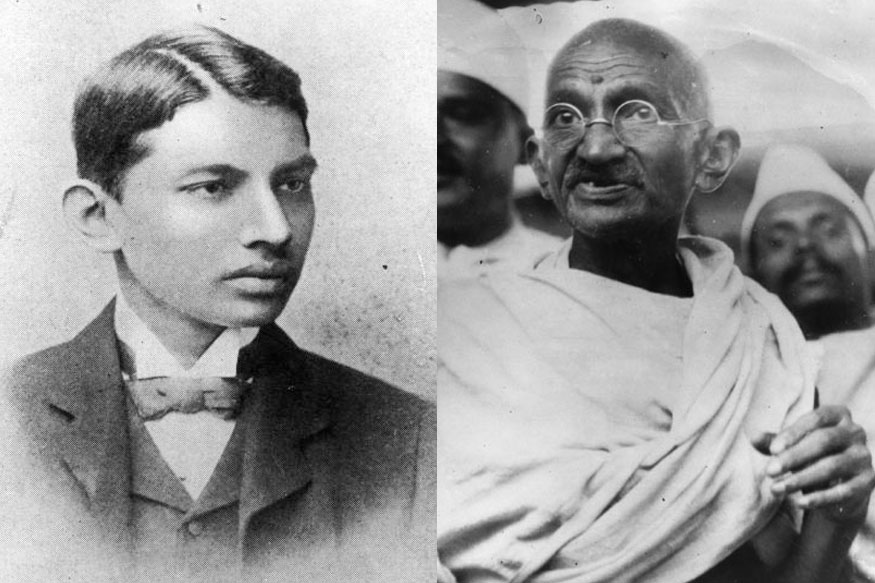
Mahatma Gandhi: 100 Rare Photos You Must See from News 18
In the image on the left, Gandhi sports a very Western European look with his hair slicked back, face shaved, and suit and bow tie. It emphasizes his place in society as a British aristocrat and intellectual. However, upon realizing the flaws of Western civilization, Gandhi strips his outward appearance of British influences and instead supports Indian manufactured clothes and wears more simplistic clothing. In the image on the right, he’s wearing hand-spun cloth wrapped around him in an Indian fashion. This transformation demonstrates the differences in identity between the British and Indians and emphasizes why the British were unfit to govern India.
I understand now that even though there may be good aspects of being under the rule of an empire, an empire is ultimately flawed in their inability to represent the conquered people. The conquered peoples want their independence and freedom in order to create a government that reflects their values and identity and most accurately represent their needs. The creation of a unified identity against a common enemy and love for one’s people will not stop a revolution from evolving.
Works Cited
- “Mahatma Gandhi: 100 Rare Photos You Must See.” News18, News18, 31 Jan. 2019, http://www.news18.com/photogallery/india/mahatma-gandhi-100-rare-photos-you-must-see-1645549.html.
- Gandhi, Mahatma, and Anthony Parel. Hind Swaraj and Other Writings. Cambridge University Press, 2013.
 Journey through the Past