At a very young age, we are taught that to be human is to be kind. Philosophers like Rousseau believed that humans were inherently compassionate and benevolent and that no human desires to abuse another. I believed in this philosophy all my life because I could not comprehend unnecessary cruelty and had faith that people want to be good. However, as I got older, I learned about the violent, inhumane acts that people have committed and was disturbed by the cruelty of their actions. Watching the intense violence from the Revenant and reading about the agonizing torture in Waiting for the Barbarians left me further bewildered to see such severe brutality. It left me questioning, if humans are inherently good, where does this intense cruelty derive from? How can another person completely brutalize and cripple another?
At its core, cruelty derives mainly from the othering and dehumanization of another group of people. Acts such as genocide happen when one fails to appreciate the humanity of others. This occurs when those in power create rigid boundaries that define what it means to be civilized and human. As a result, those that do not fit this definition of humanity are deemed as inhumane and barbaric.
Once you’ve established that a group of people are savages, it’s easier to treat them ruthlessly and strip the “other” of any sense of dignity that they have. For example, in Coetzee’s Waiting for the Barbarians, Colonel Joll mercilessly tortures Barbarian prisoners of war in order to gain evidence for his theory of a planned Barbarian invasion. Joll uses the image of the Barbarians as savage, uncivilized beings to justify his acts of torment.
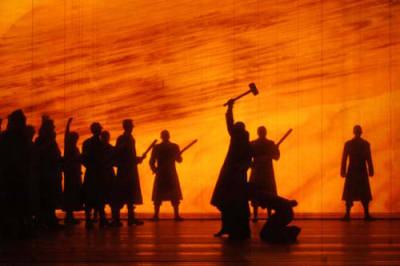
Waiting for the Barbarians Opera (2005)
Yet there still seems to be more than just the dehumanization of others that drives a person to torture another. I think that the torturer gains a certain satisfaction or thrill when they brutalize another. In part 4 of Waiting for the Barbarians, Colonel Joll’s expedition force returns with a line of barbarians, tied neck to neck. The prisoners hold their hands up to their cheeks as if suffering from a toothache because there’s a metal wire running through their hands and cheeks. The Colonel writes ENEMY on their backs with charcoal and allowed civilians to participate in the beating in order to make a spectacle of the Barbarians’ degradation and humiliation.
Humiliation. That is the true root of cruelty. Joll’s exhibition of the Barbarians’ torture was done to express the dominance of the Empire over the Barbarians and humiliate them in order to destroy any morale of the Barbarian army. By destroying their confidence, the Empire eliminates an enemy that they feel threatened by.
Thus, ultimately, the source of brutality towards groups of people derives from a desire to assert power and dominance as well as humiliate people they feel threatened by. Throughout history, we have witnessed these acts of torment inflict enormous wounds in our world. Hitler’s Nazi concentration camps are a prime example of the ugly nature of man and how fear of another group drives people to torture.
“A lot of what goes on in concentration camps is degrading and humiliating, and it’s about torturing people because you think they deserve it. It’s about the pleasure of being dominant over another person” (Illing).
Until we can take down the boundaries that we have built that other groups of people, we will be stuck in a cycle of fear and oppression that will come to define human nature as one of cruelty. Hopefully, through little steps, we can make changes to be better and learn to see everyone as one.
Works Cited
- Bloom, Paul. “The Root of All Cruelty?” The New Yorker, The New Yorker, 31 May 2018, www.newyorker.com/magazine/2017/11/27/the-root-of-all-cruelty.
- Coetzee, J. M. Waiting for the Barbarians. Minerva, 1997.
- Illing, Sean. “Why Humans Are Cruel.” Vox.com, Vox Media, 22 June 2018, www.vox.com/science-and-health/2017/12/14/16687388/cruelty-border-immigration-psychology-human-nature.
- Rousseau, Jean-Jacques, and Donald A Cress. The Basic Political Writings. W. Ross MacDonald School Resource Services Library, 2013.
 Journey through the Past