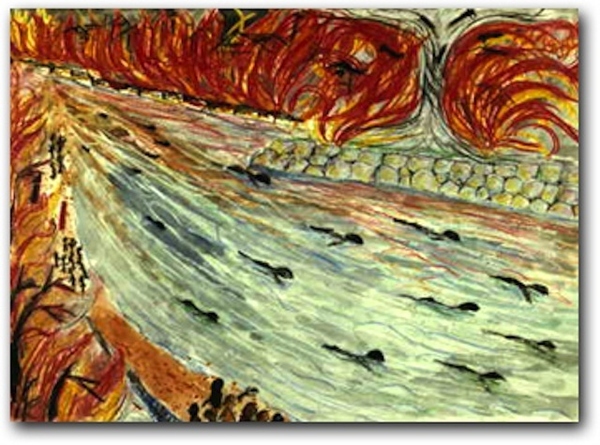
Corpses Floating in the River by Sasaki Chizuko (1945)
Through the manipulation of line, color, and texture, the tragically beautiful painting Corpses Floating in a River by Sasaki Chizuko illustrates the disastrous consequences of unchecked power and nuclear war by invoking feelings of anxiety, fear and trauma.
Upon first glance at the painting, the viewer recognizes the unconventional use of line to create a sense of disorientation and loss. Chizuko uses short, wavy lines to create texture that stir feelings of disconnectedness and separation; they show the flow of the river from the vanishing point to the front of the painting and depict the wildness and breadth of the fires. By giving the river and fire no bounds, Chizuko demonstrates the infinite lifespan of destruction and creates the illusion that these corpses are going to the Underworld. In likening the river to the River Styx from The Aeneid, the viewer’s heart weighs heavy as he feels the finality of death and the point of no return. No person killed from the nuclear bombs can come back to life. This establishes a deeply somber mood when looking at the painting and leaves the viewer questioning whether our Pyrrhic victory was truly worth the cost of our morality.
Furthermore, the juxtaposition of red and blue symbolize the loss of trust in political leadership and the perversion of human rights. On both sides of the river, fiery red dominates, burning the trees and people in its path, as well as taint the mellow blue of the river. The red has negative connotations of danger, death, and aggression, while the blue has more positive connotations of safety, trust, and peace. By showing how the red blood seeps into the river from the vanishing point, the point where the bomb and killing most likely originate, Chizuko demonstrates the infiltration and loss of safety that the Japanese felt when they were attacked. Their home, their safe haven, became a ruthless battleground for survival. The tainting of the blue river with red accentuates their loss in trust in their leaders and the world. Once the viewer feels the impact of betrayal and anger at the unnecessary loss of lives, the viewers if filled with sensations of anxiety and fear that at any point, any country can destroy and corrupt their home, leaving everyone on their toes and creating a toxic environment, in which no one can trust anyone.
The corpses in the river further accentuate the morbidity of the scene by illustrating the meaningless of human existence. This creates an existential crisis in the viewer as they think to themself how truly expendable they are in the face of war. The people looking on to the river, trapped between the fire and the river, are left with a choice to either die suffering or join their loved ones in the river for a final goodbye. These feelings of hopelessness and desperation further establish the idea that the conquest of power is not worth the lives’ of millions of people.
Through this painting, Chizuko hopes to reach out to the minds of political leaders and convince them that human warfare is detrimental to the human soul and creates an environment in which no one can live peacefully or happily. The first priority of any nation should be the welfare of its people.

 Journey through the Past
The faceless, and almost formless, corpses in the river are really interesting. I agree with you that they emphasize the expendability of citizens in war. They almost seem as though they are melting into the river. Also, they are quite a bit larger than the people on the edge of the river, which raises the question of who is more important? The destruction is clearly the focus of the painting, but I feel like the people who remain alive should be almost more important. If they didn’t exist, the government would have no reason to get better and no one to protect.
LikeLike
I really love the analysis that you put into this painting, also since it’s seems so abstract that a lot of the mood is relayed through the colors and lines used. I agree that the color blue is associated with feelings of peace and trust, however I also think it’s important that it isn’t even really a very pure color of blue, so we might argue that the color blue juxtaposes itself by also associating with anxiety and depression.
I like the point you make of the short wavy lines for disconnectedness, I think that makes a lot of sense. Between the style and the perspective of the viewer, it also seems quite messy, relating to chaos and havoc created.
Kind of in response to Alissa’s comment, I feel that instead of a focus on a “who” is more important, it is or should be more of a focus on mood, as the painting looks much more abstract than depicting a particular single subject.
LikeLike